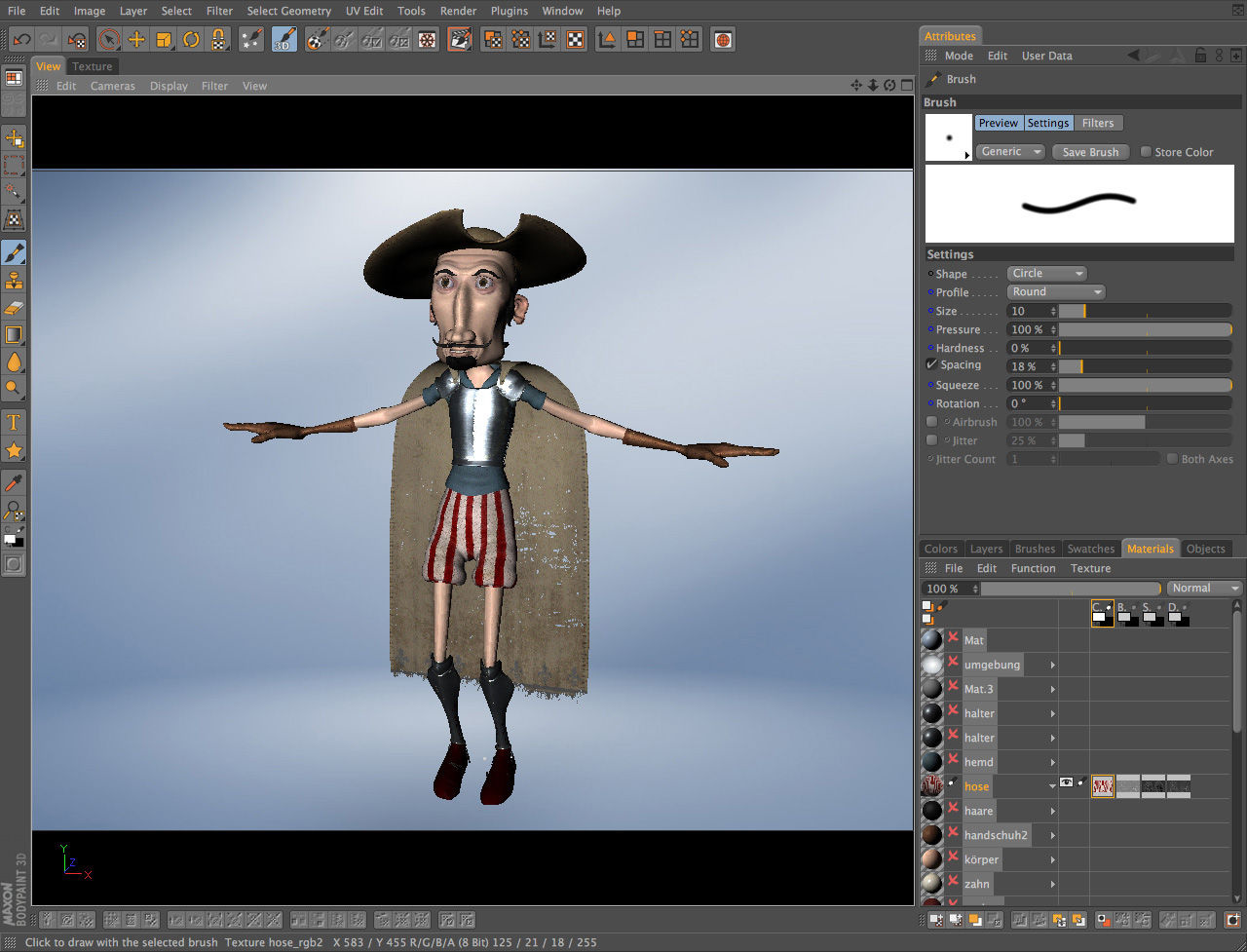

BodyPaint 3D vs Maxwell for Google SketchUp: At a Glance
BodyPaint 3D is the better choice for 3D character artists and game texture painters who need direct brush-on-mesh raster painting with Photoshop-compatible layer stacks, because no other standalone Mac tool matches its UV-projection precision at that price point; Maxwell for Google SketchUp suits architects and product visualization artists because its physically-based spectral renderer produces scientifically accurate material behavior — caustics, subsurface scattering, chromatic aberration — directly inside SketchUp's modeling environment. Both tools live in the 3D graphic design software space but solve opposite ends of the same pipeline: BodyPaint 3D authors the painted texture maps that go onto a model, while Maxwell renders the final photorealistic image of that model under physically accurate light. The split in the bodypaint 3d vs maxwell for google sketchup decision comes down to whether you need to create surface color and detail or render a finished scene.
---
Where BodyPaint 3D Wins
Multi-Layer Raster Painting Directly on Geometry
BodyPaint 3D's RayBrush mode projects brushstrokes along surface normals rather than screen space, which means painting a curved shoulder or car fender produces zero smearing at UV seam edges. Each layer carries independent fill, opacity, and blend settings comparable to Photoshop's layer stack. Pressing F1–F4 switches instantly between UV editor, 3D paint view, material manager, and render view — a four-key shortcut loop that keeps interruption to zero. Maxwell for SketchUp has no brush-based texture authoring whatsoever; its material system accepts imported maps but cannot paint them.
Photoshop-Compatible Plugin Pipeline
Third-party brush engines and texture-generation plugins load via Edit > Preferences > Plugins without rebuilding preset libraries. Exported PSD files preserve the full layer stack — diffuse, normal, and specular channels all intact — so a raster workflow that starts in BodyPaint 3D lands in Photoshop or Affinity Photo without flattening. Batch-exporting all texture channels at once through File > Export Textures writes every map in a single pass. ICC color profile embedding on TIFF and PNG export keeps color accurate from a sRGB IEC61966-2.1 working space through to a print-ready 300 dpi deliverable.
---
Where Maxwell for Google SketchUp Wins
Physically Based Spectral Rendering
Maxwell's BSDF shader system calculates light interaction at a spectral level, producing accurate color temperature shifts and chromatic aberration that V-Ray for SketchUp approximates but does not replicate with the same scientific fidelity. A 1920×1080 architectural interior renders in roughly 45 minutes on an 8-core CPU — slow by V-Ray standards but with measurably superior glass caustics and metal gradients. BodyPaint 3D has no comparable final-image renderer in its standalone form; it relies on Cinema 4D or a third-party engine for output beyond a basic OpenGL preview.
Multilight and HDR Environment System
Maxwell's multilight system outputs each light source as a separate layer inside an OpenEXR container, letting colorists in Nuke or After Effects adjust sun intensity, artificial fill, and emission materials after the render completes — no re-render required. HDR environment lighting loads through the Environment panel, delivering accurate reflections across every surface's gradient and fill. ProRes QuickTime export is available for animation sequences. BodyPaint 3D exports only static raster maps; it has no animated texture or EXR multi-pass output in the standalone build.
---
Head-to-Head: Feature Comparison
The bodypaint 3d vs maxwell for google sketchup gap is widest on two rows: rendering capability (Maxwell wins outright — BodyPaint 3D has none in standalone) and texture authoring (BodyPaint 3D wins outright — Maxwell accepts maps but cannot paint them). Every other row reflects genuine trade-offs worth weighing against your specific deliverable.
| Aspect | BodyPaint 3D | Maxwell for Google SketchUp | |
|---|---|---|---|
| License | Trial | Freemium | |
| Price / entry tier | Trial download (Maxon subscription required for full) | Free tier available; Pro tier paid | |
| Platforms | macOS only (universal binary: Apple Silicon + Intel) | [[platform:windows | Windows]] 10/11 and macOS 10.14+ |
| Key export formats | PSD, PNG (8/16-bit), TIFF, JPEG, OpenEXR | EXR (multilight passes), PNG, TIFF, JPEG, BMP, ProRes QT | |
| Color management | ICC-aware; sRGB, AdobeRGB, linear workflows | ICC-aware; sRGB, AdobeRGB, ProPhoto RGB; LUT on export | |
| Texture / painting | Full multi-layer raster painting on UV-mapped meshes | Import only — no brush-based painting | |
| Rendering engine | OpenGL viewport preview only (standalone) | Maxwell spectral CPU renderer; network rendering supported | |
| Plugin ecosystem | Photoshop-compatible plugins via Edit > Preferences > Plugins | SketchUp Ruby API; version-matched installer required | |
| Learning curve | Intermediate (familiar to Photoshop/Cinema 4D users) | Steep (requires understanding of photographic exposure principles) | |
| Update / host dependency | Standalone + Cinema 4D module | Requires SketchUp Make 2017 or SketchUp Pro 2018+ |
The rendering row is the decisive one: architects who need a magazine-ready image cannot use BodyPaint 3D as their final output tool. Conversely, game artists who need hand-painted diffuse maps have no path to that output inside Maxwell.
---
Verdict by Use Case
- Painting hand-crafted character textures for a game engine → choose BodyPaint 3D because its RayBrush projection and multi-layer stack produce seam-free raster maps at 4096×4096 per UV tile that Maxwell cannot author at all.
- Producing a print-ready 300 dpi architectural visualization at large format → choose Maxwell for Google SketchUp because its spectral renderer and 16-bit TIFF export with embedded ICC profile maintain smooth color gradients and accurate material fills through to press output.
- Iterating quickly on lighting for a client presentation → choose Maxwell for Google SketchUp because Fire mode delivers a 30-second preview and the multilight EXR lets you adjust individual light source brightness in post without re-rendering.
- Building a long-term texture-painting skill transferable to Cinema 4D or a Substance pipeline → choose BodyPaint 3D because its layer, blend-mode, and UV-projection vocabulary maps directly onto Maxon's broader subscription ecosystem and Substance 3D Painter's comparable concepts, giving you portable knowledge.
---
Common Questions
Q: Can BodyPaint 3D render a final photorealistic image on its own?
A: No — the standalone BodyPaint 3D build provides only an OpenGL viewport preview and has no production renderer. Final photorealistic output requires passing the painted mesh into Cinema 4D (where BodyPaint 3D is also available as a module) or a third-party renderer. Artists who need both texture painting and final rendering in one app should evaluate Substance 3D Painter, which includes a baked-preview renderer, or use BodyPaint 3D alongside Maxwell or another engine.
Q: Does Maxwell for Google SketchUp support vector or SVG output for print graphics?
A: No — Maxwell outputs raster formats only (EXR, TIFF, PNG, JPEG, BMP). Neither Maxwell nor BodyPaint 3D produce vector paths, SVG, or anchor-point-based illustration output. For print workflows requiring scalable vector artwork alongside a rendered image, the rendered raster would need to be imported into Illustrator or Affinity Designer for any typography, stroke, or bezier curve overlays.
Q: Which program runs natively on Apple Silicon Macs?
A: BodyPaint 3D ships as a universal binary and runs natively on M1, M2, and M3 chips with full performance. Maxwell for Google SketchUp on Apple Silicon runs through Rosetta 2 translation with a documented 15–20% performance penalty compared to native Intel execution. For M-series Mac users doing heavy render work, that overhead adds meaningful time to already long Maxwell render passes — a 45-minute interior render could extend to 52–54 minutes under translation.